An RTX 5090 connector melts when its 575W load piles onto a few pins of the 16-pin 12V-2×6 plug. The usual causes are a plug that is not fully seated, a hard bend near the socket, or an adapter that adds resistance. The short version: use an ATX 3.1 power supply of at least 1000W, run a native 12V-2×6 cable with no adapter, push the plug in until it clicks flush, and keep the cable straight for the first few centimeters. That cuts the risk sharply, but nothing removes it completely. With the card selling for $6,199 to $6,599 as of mid-November 2026, a burnt socket is an expensive problem.

Why do RTX 5090 connectors melt?
They melt because the connector runs very close to its rated limit, so any extra resistance turns into heat.
The 12V-2×6 plug carries power over six 12V pins and six ground pins, plus four small sense pins. The connector is rated for 600W. The RTX 5090 has a total graphics power of 575W. That is roughly 48 amps at 12 volts, or about 8 amps per pin if every pin shares the load equally.
Each pin is commonly rated around 9.5 amps. So the margin per pin is thin. If two pins make poor contact, the remaining four carry more current than they were designed for. Resistance at a bad contact also rises, and heat follows. Plastic around the pin softens, the contact gets worse, and the cycle feeds itself.
The usual triggers
- Partial insertion: the plug looks seated but sits a millimeter short of the latch.
- Sharp bends: a tight bend right at the plug levers some pins away from their sockets.
- Sideways strain: a side panel pressing on the cable pulls the plug at an angle.
- Adapters and extensions: every extra joint adds contact resistance.
- Worn plugs: repeated unplugging loosens the terminals over time.
The connector is not failing at random. It fails where current concentrates, and current concentrates wherever contact is weakest.
What changed from 12VHPWR to 12V-2×6?
12V-2×6 redesigned the pin lengths so a loose plug is more likely to shut power off, but it kept the same 16-pin footprint and 600W rating.
The RTX 4090 used the original 12VHPWR connector at 450W. Melt reports on that card pushed the industry toward the revised 12V-2×6 header. The new version lengthens the conductor pins and shortens the sense pins. In theory, a plug that is not fully seated loses its sense signal first, and the card refuses to draw full power.
That fix helps with the most common mistake. It does not address uneven current between pins on a fully seated plug. The RTX 5090 also draws 125W more than the 4090 through the same size connector. That is why reports have continued into 2026.
| Card | Power rating | Connector | Share of 600W limit | Recommended PSU |
|---|---|---|---|---|
| RTX 5090 | 575W TGP | 12V-2×6 | ~96% | 1000W |
| RTX 4090 | 450W | 12VHPWR | ~75% | 850W+ (typical) |
| RTX 5080 | 360W TGP | 12V-2×6 | ~60% | 850W |
| RTX 5070 Ti | 300W TGP | 12V-2×6 | ~50% | 750W+ (typical) |
| RX 9070 XT | 304W board power | 8-pin or 12V-2×6 (varies) | ~51% on 12V-2×6 models | 750W+ (typical) |
Which cards have melted?
The RTX 5090 gets the headlines, but melt reports cover several cards that use the 12V-2×6 connector.
Guru3D reported in February 2026 that a Gigabyte AORUS RTX 5090 Master ICE melted even while its power was limited to 500W. That case matters because power limiting is the most common advice for nervous owners. It shows a lower cap reduces risk without eliminating it.
Reports have also surfaced for the RTX 5080, the RTX 5070 Ti and some RX 9070 XT models that use 12V-2×6. Those cards draw far less power, so incidents are rarer. Still, the pattern is the same: one weak contact, concentrated current, local heat.
No GPU brand is immune, but risk scales with load. A 575W RTX 5090 runs the 12V-2×6 connector near its 600W rating, while a 304W RX 9070 XT uses about half of it.
How do you prevent a melted connector?
Use the right power supply and cable, seat the plug completely, and route the cable with no strain on the connector.
Power supply and cable
- Use an ATX 3.1 power supply rated at 1000W or more, as NVIDIA recommends for the RTX 5090.
- Use the native 12V-2×6 cable that came with that power supply.
- Skip the 4x 8-pin adapter if your supply has a native cable.
- Never mix modular cables between PSU brands. Pinouts on the PSU side are not standardized.
- Avoid third-party extensions and 90-degree adapters unless the PSU maker certifies them.
Installation
- Push the plug in straight until the latch clicks. Check that there is no visible gap at any edge.
- Keep the first 35mm or so of cable straight before any bend.
- Make sure the side panel does not press on the cable.
- Do not let the cable hang with its weight pulling the plug sideways.
- Limit how often you unplug and replug the connector.
Monitoring
- Watch for a burning plastic smell, black screens under load or sudden shutdowns.
- Some PSUs and cards report per-pin current or connector temperature. Use it if yours does.
- Inspect the plug after the first week and after moving the PC.
Our power supply guide covers wattage sizing in more detail.
Most failures start with a plug that is not fully seated or a cable under strain. A native cable, full insertion and a straight run near the socket remove the most common causes.
What should you do if your connector already melted?
Shut the PC down, unplug it from the wall, and do not power it on again until both the card and cable are inspected.
Photograph the plug and the socket before you touch anything. Retailers and board partners usually want clear photos for a warranty claim. Replace the cable even if it looks fine at the PSU end. A melted socket on the card is a board repair, not a user fix.
Contact the card maker first, then the PSU maker if the PSU-side plug is also damaged. Keep your receipt and the original packaging. Replacement may be slow, because RTX 5090 supply is constrained. Newegg’s November 15 restock, reported by Tom’s Hardware, listed the cheapest air-cooled models at roughly three times the $1,999 launch price, limited to one per customer.
Is an RTX 5090 still worth buying?
The RTX 5090 is still the fastest gaming card you can buy, but at over $6,000 the value case is weak for most gamers.
The performance gap is real. A 3DMark Speed Way result reported by SpecPicks put the RTX 5090 at 15,488 against 9,010 for the RTX 5080. It also has 32GB of GDDR7 and DLSS 4 Multi Frame Generation. If you game at 4K with path tracing, nothing else matches it.
The cost is the problem. The card launched at $1,999. As of mid-November 2026 it starts around $6,199 to $6,599. Add a 1000W ATX 3.1 supply, careful cable work and some lingering connector risk. Rumours of discontinuation are unconfirmed; NVIDIA said shipments would continue, though supply is tight. Our breakdowns of RTX 5090 pricing and the discontinuation rumour go deeper.
For 1440p and most 4K gaming, a 304W card like the RX 9070 XT is far easier to power and cool. It uses FSR 4 for upscaling. See our RX 9070 XT vs RTX 5070 Ti comparison and DLSS 4 vs FSR 4 for the trade-offs.
Buy an RTX 5090 only if you need its raw 4K performance and accept the price and power demands. For most players, a lower-power card in a properly built system is the smarter spend.
Looking for a gaming PC?
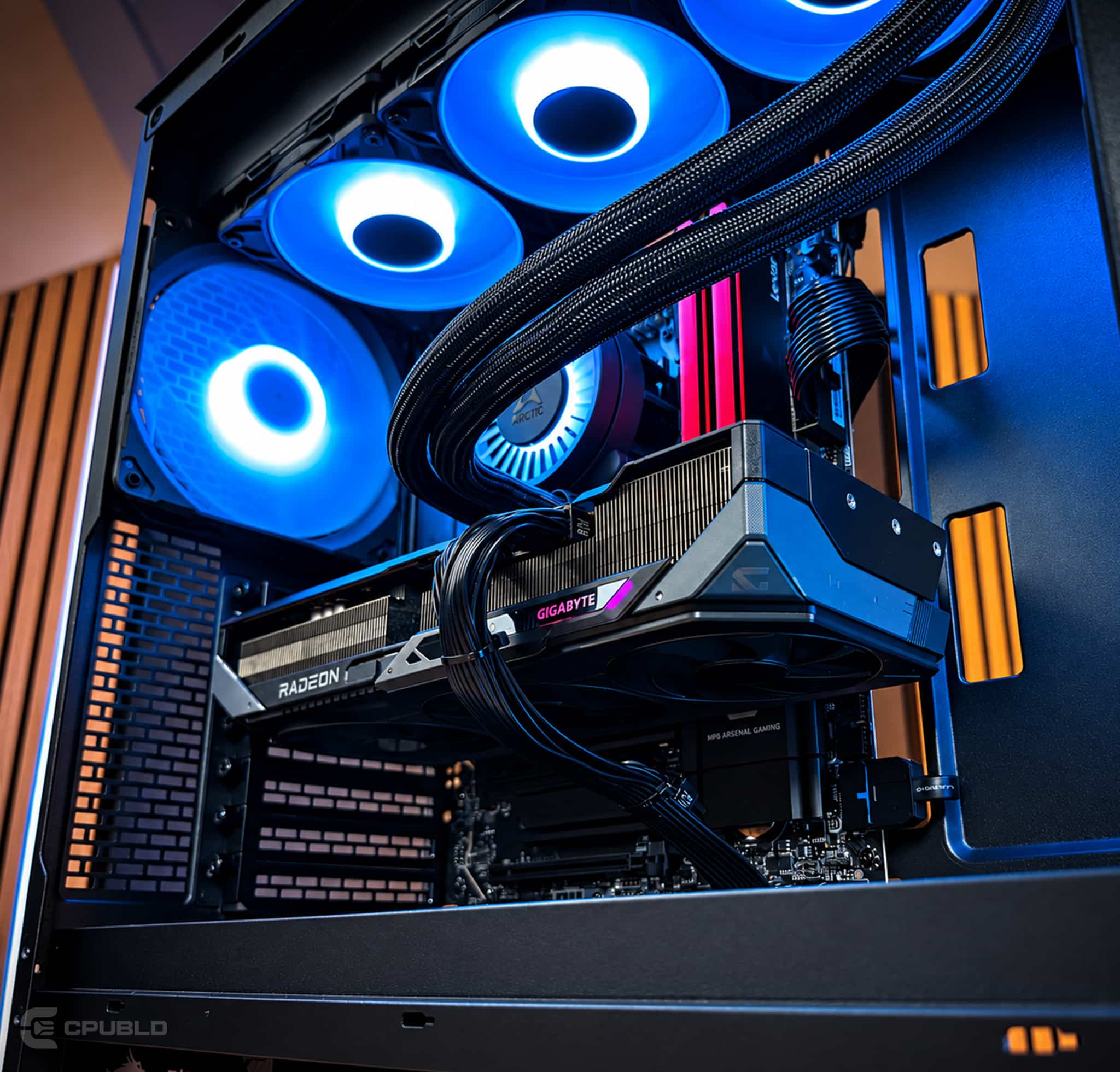
If connector worries and $6,000 GPU prices have you rethinking, OCEAN is a complete, tested system built around a 304W RX 9070 XT. It pairs that card with a Ryzen 7 9800X3D and an 850W 80+ Gold supply, so the power side runs well within its limits. Every cable is routed by hand during assembly.
- CPU AMD Ryzen 7 9800X3D
- GPU Gigabyte Radeon RX 9070 XT 16GB GAMING OC
- Motherboard MSI MAG B850 TOMAHAWK MAX WIFI
- Memory Lexar THOR Z OC 32GB DDR5-6000
- Storage Kingston NV3 2TB NVMe
- Cooling ARCTIC Liquid Freezer III Pro A-RGB 360
- Case Phanteks XT PRO ULTRA
- Power MSI MAG A850GL 850W 80+ Gold
- OS Windows 11 Pro
OCEAN ships within 5–7 business days. It is hand-assembled in Jersey City, cable-managed and burn-in tested for 48 hours under full load before it leaves. You get a 3-year parts warranty, lifetime support and fully insured shipping to all 50 states. Affirm financing offers 0% APR options for qualified buyers.
Want an RTX 5090 or RTX 5080 build with a properly sized ATX 3.1 supply and native cabling? Tell us on the request form and you’ll get a parts plan and quote within 24 hours. GPU street prices change daily, so availability and price are confirmed in the quote. Or browse all of our prebuilt gaming PCs.
Frequently asked questions
Why do RTX 5090 power connectors melt?
Most melts trace back to too much current flowing through too few pins. A partly seated plug, a sharp bend near the connector or a worn adapter raises resistance on some contacts. Those contacts heat up, and at 575W there is little safety margin left to absorb the extra heat.
Is 12V-2×6 safer than 12VHPWR?
It is an improvement, not a cure. 12V-2×6 uses longer power pins and shorter sense pins, so a loose plug is more likely to cut power instead of running hot. Melt reports still continue in 2026, so correct installation and a native cable from an ATX 3.1 supply still matter.
Does power limiting an RTX 5090 stop melting?
It lowers risk but does not remove it. Guru3D reported in February 2026 that a Gigabyte AORUS RTX 5090 Master ICE melted while limited to 500W. Power limiting cuts total current, yet one poorly seated pin can still overheat if the load spreads unevenly across the contacts.
What power supply should I use for an RTX 5090?
NVIDIA recommends a 1000W power supply for the RTX 5090. Choose a quality ATX 3.1 unit with a native 12V-2×6 cable. Avoid adapters, extensions and cables borrowed from another brand of supply. Pin layouts on the PSU side are not standardized, and a mismatched cable can damage hardware.
Do AMD graphics cards have melting connector problems?
Melts have been reported on some RX 9070 XT cards that use the 12V-2×6 connector, so AMD is not immune. Many RX 9070 XT models use traditional 8-pin connectors instead. The card draws 304W of board power, which leaves far more headroom than a 575W RTX 5090.


