
The best 1440p 240Hz gaming PC in November 2026 pairs a Ryzen 7 9800X3D with a Radeon RX 9070 XT 16GB. Add 32GB of DDR5-6000 and an 850W Gold power supply. That combination holds 240 FPS in competitive shooters and pushes high refresh in AAA games with FSR 4. The short version: buy the fastest gaming CPU you can, then stop GPU spending before you pay double MSRP.
GPU prices are the hard part this year. A memory shortage has pushed NVIDIA cards far above launch pricing, while the RX 9070 XT has stayed comparatively sane. Below is the full parts plan, two example builds and an honest look at when an RTX 5080 or RTX 5090 makes sense.
What does 1440p at 240Hz actually demand?
A 240Hz panel shows a new frame every 4.17 milliseconds, so your PC must finish each frame inside that window.
That budget splits two ways. In esports titles like Valorant and CS2, the CPU is usually the limit, because the GPU finishes its work quickly. In AAA games, the GPU becomes the limit, especially with ray tracing turned on.
So a 1440p 240Hz build has to be balanced. A weak CPU caps your frame rate in shooters no matter how big the GPU is. A weak GPU forces you to drop settings in single-player games. If you want the full resolution primer, our 1440p specs guide covers lower refresh targets too.
| Refresh rate | Frame time budget | Main bottleneck at 1440p |
|---|---|---|
| 144Hz | 6.94 ms | GPU in most games |
| 165Hz | 6.06 ms | GPU in most games |
| 240Hz | 4.17 ms | CPU in esports, GPU in AAA |
| 360Hz | 2.78 ms | CPU and memory latency |
Which CPU is best for 1440p 240Hz?
The Ryzen 7 9800X3D is the best CPU for a 240Hz build because its large cache keeps frame times short and steady.
Ryzen 7 9800X3D key specs
- 8 cores and 16 threads
- 96MB of L3 cache thanks to 3D V-Cache
- 120W TDP, easy to cool with a good 360mm AIO
- AM5 socket, so the platform has room for future upgrades
Games constantly fetch the same data about players, physics and world state. A big L3 cache keeps more of that close to the cores, which cuts stalls. That matters most when you are chasing 240 FPS, because every stall shows up as a dropped frame.
Eight cores are plenty for gaming plus Discord and a browser. If you also render video or stream heavily, see our 9800X3D vs 9950X3D comparison. For whether it still leads in late 2026, read our 9800X3D check-in.
At 240Hz, the CPU sets the ceiling in competitive games. The Ryzen 7 9800X3D, with 96MB of L3 cache, is the safest pick for high, stable frame rates.
Which GPU should you pair with it?
The RX 9070 XT is the best value GPU for 1440p 240Hz, while the RTX 5090 is the fastest at any price.
Street prices in mid-November 2026 tell the story. NVIDIA cards using GDDR7 memory have taken the biggest hits from the memory shortage. Hardware Unboxed data cited by Notebookcheck showed the RTX 5070 Ti, 5080 and 5090 rose the most. The RX 9070 XT stayed comparatively in check.
| GPU | VRAM | Power | Launch MSRP | Street price (mid-Nov 2026) |
|---|---|---|---|---|
| RX 9070 XT | 16GB GDDR6 | 304W | $599 | ~$700 to $1,000 |
| RTX 5070 Ti | 16GB GDDR7 | 300W | $749 | ~$1,170 (Newegg, Oct 3) |
| RTX 5080 | 16GB GDDR7 | 360W | $999 | ~$1,800 to $2,300+ |
| RTX 5090 | 32GB GDDR7 | 575W | $1,999 | ~$6,200 to $6,600+ |
Why the RX 9070 XT fits 240Hz
- 16GB of VRAM covers 1440p textures with headroom
- FSR 4 upscaling lifts frame rates in demanding AAA games
- 304W board power runs comfortably on an 850W unit
- It costs a fraction of an RTX 5080 at today’s prices
The RTX 5070 Ti is a close rival with DLSS 4 Multi Frame Generation. At roughly $1,170, though, it costs far more than its $749 launch price. We break that matchup down in RX 9070 XT vs RTX 5070 Ti, and the upscaler question in DLSS 4 vs FSR 4.
How much RAM, storage and power do you need?
Plan on 32GB of DDR5-6000, a 2TB NVMe SSD and an 850W 80+ Gold power supply.
Memory
- 32GB is the sweet spot for gaming with apps open in the background
- DDR5-6000 is the speed AM5 X3D chips handle best
- Tom’s Hardware put a 32GB DDR5-6000 kit at about $450 in November 2026
- The same class of kit was well under $150 in 2025
That jump is why parts lists look so expensive this fall. JP Morgan expects DRAM prices to be up about 400% since 2024 by the end of this year, according to Engadget. Our DDR5 price explainer covers why.
Storage and power
- A 2TB NVMe drive holds several modern 100GB+ games plus your esports library
- An 850W 80+ Gold unit suits both the RX 9070 XT and the RTX 5080
- An RTX 5090 needs a 1000W unit, per NVIDIA’s recommendation
- Use an ATX 3.1 PSU with a native 12V-2×6 cable for any card using that connector
Connector melt reports continue in 2026 across RTX 5090, 5080, 5070 Ti and some RX 9070 XT models with 12V-2×6. Seat the plug fully, avoid adapters and keep sharp bends away from the connector. Read more in our melting connector guide and our power supply guide.
What do example 1440p 240Hz builds look like?
A balanced RX 9070 XT build runs about $2,800 in parts today, while an RTX 5080 version climbs past $4,000.
- CPU AMD Ryzen 7 9800X3D
- GPU Radeon RX 9070 XT 16GB
- Memory 32GB DDR5-6000
- Storage 2TB NVMe SSD
- Cooling 360mm AIO liquid cooler
- Power 850W 80+ Gold, ATX 3.1
- OS Windows 11
- CPU AMD Ryzen 7 9800X3D
- GPU GeForce RTX 5080 16GB
- Memory 32GB DDR5-6000
- Storage 2TB NVMe SSD
- Cooling 360mm AIO liquid cooler
- Power 850W 80+ Gold, ATX 3.1, native 12V-2×6
- OS Windows 11
Both builds share the same CPU, memory and storage. The only real difference is roughly $800 to $1,600 of GPU premium. Prices here are approximate as of mid-November 2026 and move daily.
At 1440p 240Hz, the CPU decides how high your frame rate can go. The GPU decides how much eye candy you keep along the way.
Is an RTX 5080 or RTX 5090 worth it for 1440p 240Hz?
The RTX 5090 is still the fastest gaming GPU, but at about three times MSRP it is poor value for a 1440p monitor.
The raw gap is real. SpecPicks reported a 3DMark Speed Way score of 15,488 for the RTX 5090 versus 9,010 for the RTX 5080. That is roughly 72% more GPU muscle. At 1440p, though, the CPU often caps frame rates first, so much of that extra power goes unused.
Price is the bigger issue. Tom’s Hardware reported on November 15 that Newegg restocked 21 RTX 5090 models. The cheapest air-cooled cards started around $6,599, limited to one per customer. RTX 5080 cards sit roughly between $1,800 and $2,300+.
What about waiting?
- The 24GB RTX 5080 was reportedly cancelled, per Board Channels on November 11; NVIDIA never announced it
- October rumours of RTX 5090 and 5080 discontinuation remain unconfirmed, and NVIDIA said 5090 shipments continue
- Silicon Motion expects memory shortages to last until 2028
In short, waiting for a cheaper NVIDIA card is a gamble. Our buy now or wait guide covers the timing question in detail.
Buy an RTX 5090 only if you play at 4K or need 32GB of VRAM. For 1440p 240Hz, a 9800X3D with an RX 9070 XT delivers most of the experience for a fraction of the cost.
How do you set up a 240Hz PC correctly?
Plug into the GPU, enable the full refresh rate in Windows and turn on the memory profile in the BIOS.
- Connect the monitor to the graphics card, not the motherboard
- Use DisplayPort and set 240Hz in Windows display settings
- Enable EXPO so your DDR5 runs at its rated 6000 MT/s
- Turn on adaptive sync to smooth dips below 240 FPS
- Use competitive presets in shooters and FSR 4 in AAA titles
Need a screen to match? Our RX 9070 XT monitor guide compares 1440p, 4K and ultrawide options. If you mainly play competitive shooters, also see our esports PC guide.
Looking for a 1440p 240Hz gaming PC?
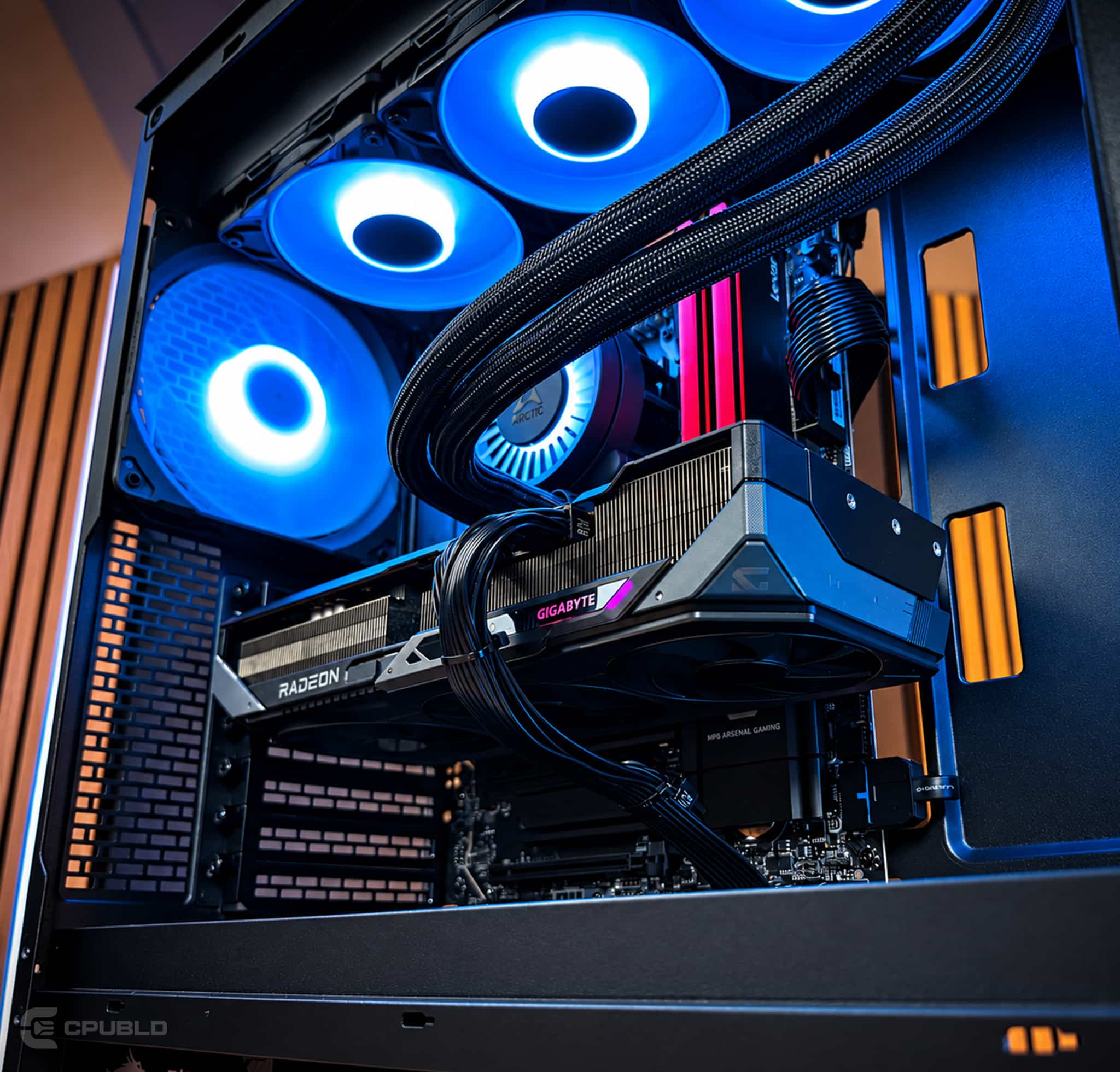
OCEAN is our ready-to-ship build for exactly this target. It uses the Ryzen 7 9800X3D and RX 9070 XT combination recommended above, with 32GB of DDR5-6000 and an 850W Gold supply.
- CPU AMD Ryzen 7 9800X3D
- GPU Gigabyte Radeon RX 9070 XT 16GB GAMING OC
- Motherboard MSI MAG B850 TOMAHAWK MAX WIFI
- Memory Lexar THOR Z OC 32GB DDR5-6000
- Storage Kingston NV3 2TB NVMe
- Cooling ARCTIC Liquid Freezer III Pro A-RGB 360
- Case Phanteks XT PRO ULTRA
- Power MSI MAG A850GL 850W 80+ Gold
- OS Windows 11 Pro
OCEAN ships within 5–7 business days. Every unit is hand-assembled and cable-managed in Jersey City, then runs a 48-hour burn-in under full load before it leaves. You get a 3-year parts warranty, lifetime support and fully insured shipping to all 50 states. Affirm financing offers 0% APR options for qualified buyers.
Need a different spec, like an RTX 5080 or RTX 5090 build for 1440p? Tell us on the request form and you’ll get a parts plan and quote within 24 hours. GPU street prices change daily, so the quote confirms availability and price. Custom builds ship 2–3 weeks after approval. Or browse all of our prebuilt gaming PCs.
If you want 1440p 240Hz without the RTX 5090 markup, OCEAN ships in 5–7 business days with the parts this guide recommends.
Frequently asked questions
What PC do you need for 1440p 240Hz?
You need a fast gaming CPU, a strong 16GB GPU and 32GB of DDR5. A Ryzen 7 9800X3D with a Radeon RX 9070 XT, 32GB of DDR5-6000 and an 850W Gold power supply is a balanced choice. It holds 240 FPS in esports titles and runs AAA games well with FSR 4.
Can the RX 9070 XT run 240 FPS at 1440p?
Yes, in competitive shooters like Valorant and CS2 with a fast CPU such as the Ryzen 7 9800X3D. In demanding AAA games, expect lower native frame rates. FSR 4 upscaling helps close that gap. Its 16GB of VRAM also leaves headroom for high-resolution textures at 1440p.
Is the RTX 5090 overkill for 1440p?
For most players, yes. The RTX 5090 is the fastest gaming GPU, but at 1440p the CPU often limits frame rates first. In mid-November 2026, Newegg listings started around $6,599, roughly three times its $1,999 launch price. That money is better spent elsewhere unless you also game at 4K.
How much RAM do you need for 1440p 240Hz gaming?
32GB of DDR5-6000 is the right amount for a 240Hz build. It covers modern games plus Discord, a browser and launchers running in the background. DDR5 prices are high in late 2026, with 32GB kits around $450 to $550, so 64GB is rarely worth it for gaming alone.
What power supply does a 1440p 240Hz PC need?
An 850W 80+ Gold ATX 3.1 unit covers a Ryzen 7 9800X3D with an RX 9070 XT or an RTX 5080. NVIDIA recommends 1000W for the RTX 5090. For cards using 12V-2×6, use a native cable from the power supply, seat it fully and avoid sharp bends.


