
The best gaming PC under $3,000 in November 2026 pairs an AMD Ryzen 7 9800X3D with a Radeon RX 9070 XT 16GB. Add 32GB of DDR5-6000 and a 2TB NVMe SSD. That combination fits under $3,000 as a complete, tested system. An RTX 5080 card alone now runs roughly $1,800 to $2,300+, so it cannot anchor a balanced build at this budget. The short version: put your money into the 9800X3D and RX 9070 XT, and buy 32GB of DDR5 once. Skip NVIDIA’s top cards until prices settle.
What does $3,000 buy in late 2026?
In mid-November 2026, $3,000 buys a top-tier gaming CPU and an upper-high-end GPU, but not NVIDIA’s flagship class.
Two years ago this budget bought an RTX 4090-class system. Today a memory shortage has changed the math. AI data centers are buying DRAM and HBM years in advance. HBM competes for the same wafer capacity as DRAM and GDDR memory.
The fallout lands on gamers in two places. First, graphics cards with GDDR7, which means every RTX 50 card, are supply constrained. Second, system memory has exploded in price. Tom’s Hardware put a 32GB DDR5-6000 kit at about $450 in November 2026. The same kit was well under $150 in 2025.
JP Morgan expects DRAM prices to have risen about 400% since 2024 by the end of this year, according to Engadget. Silicon Motion expects the shortage to last until 2028. Waiting for a return to 2024 prices could mean waiting a long time.
So a smart $3,000 build in 2026 is about allocation. Every dollar wasted on an overpriced GPU comes straight out of RAM, storage and power supply quality.
The best parts list under $3,000
The parts below form the strongest balanced gaming build you can get for under $3,000 right now.
| Component | Pick | Key spec | Street price (mid-Nov 2026) |
|---|---|---|---|
| CPU | AMD Ryzen 7 9800X3D | 8 cores / 16 threads, 96MB L3 | ~$470 |
| GPU | Radeon RX 9070 XT 16GB | 16GB GDDR6, 304W, FSR 4 | $700 to $1,000 |
| Motherboard | B850 with Wi-Fi | AM5, PCIe 5.0 M.2 | ~$230 |
| Memory | 32GB DDR5-6000 | 2 x 16GB | $450 to $550 |
| Storage | 2TB NVMe SSD | PCIe 4.0 | ~$150 |
| Cooler | 360mm AIO | Triple 120mm fans | ~$100 |
| Power supply | 850W 80+ Gold | ATX 3.1 class | ~$110 |
| Case | Mid-tower, high airflow | 360mm radiator support | ~$90 |
| OS | Windows 11 Pro | Retail license | ~$200 |
Prices marked “~” are approximate. GPU and RAM ranges come from US listings tracked this fall. The total lands between roughly $2,500 and $2,900 before tax and shipping.
Where the money goes
- GPU and RAM: about half of the budget, because both depend on scarce memory chips.
- CPU: the 9800X3D is the one part worth paying full price for. It stays relevant through several GPU upgrades.
- Platform: AM5 gives you a socket with an upgrade path, unlike a dead-end platform.
- Power and cooling: about $210 combined. Never trim here to afford a bigger GPU.
At $3,000, roughly half your budget now goes to the GPU and RAM. A 9800X3D plus RX 9070 XT is the pairing that leaves enough for a quality 850W PSU, 2TB of storage and a 360mm cooler.
Why an RX 9070 XT instead of an RTX card?
The RX 9070 XT is the best GPU under $3,000 because its price has stayed close to launch while NVIDIA’s cards have not.
AMD launched the RX 9070 XT at $599. US listings this fall ranged from roughly $700 to $1,000 depending on model. Data from Notebookcheck and Hardware Unboxed showed the RTX 5070 Ti, 5080 and 5090 suffered the worst increases.
The RTX 5080 does not fit
- Launch MSRP: $999.
- Mid-November 2026 street price: roughly $1,800 to $2,300+. VideoCardz found Best Buy selling a PNY RTX 5080 at $1,999.99.
- Remaining budget for everything else: $700 to $1,200, while 32GB of DDR5 alone costs about $450.
The 24GB RTX 5080 refresh will not rescue this budget either. Board Channels reported on November 11 that its launch was cancelled. NVIDIA never announced it, so treat it as reportedly cancelled.
The RTX 5070 Ti is the honest alternative
- Launch MSRP: $749. Newegg listed it at $1,169.99 on October 3, 2026, per Digital Citizen.
- Specs: 16GB GDDR7, 300W, DLSS 4 Multi Frame Generation.
- It fits under $3,000, but costs about $170 to $470 more than an RX 9070 XT for the same performance class.
Pick the 5070 Ti if you play heavy ray-traced or path-traced games and want DLSS 4. For most players, the RX 9070 XT with FSR 4 is the better value. Our RX 9070 XT vs RTX 5070 Ti comparison covers the trade-off in depth.
The RTX 5090 is still the fastest gaming card you can buy. At $6,199 or more for the card alone, it simply belongs to a different budget.
A Newegg price report cited November 13 showed the cheapest new RTX 5090 at $6,199.99. That is more than double this entire build.
Why the Ryzen 7 9800X3D is the CPU to buy
The Ryzen 7 9800X3D is the best gaming CPU at any budget, so it belongs in every high-end build.
Its 96MB of L3 cache uses AMD’s 3D V-Cache. Games that hit the cache hard, like simulators, MMOs and competitive shooters, gain the most. It runs 8 cores and 16 threads at a 120W TDP on the AM5 socket.
That modest 120W figure matters. A 360mm AIO keeps it cool and quiet under long sessions. It also leaves more of an 850W power supply’s headroom for the GPU.
A stronger CPU also protects your investment. When GPU prices eventually ease, you can drop in a faster card without replacing the platform. See whether the 9800X3D is still the best gaming CPU for the full case.
What performance should you expect?
This build is a high-refresh 1440p machine that also handles 4K with upscaling.
- Esports at 1440p: well above 200 FPS in titles like Valorant and Counter-Strike 2 on high settings.
- AAA at 1440p: high to ultra settings at high refresh rates in most games, with FSR 4 for extra headroom.
- 4K: playable in most games at high settings, especially with FSR 4 upscaling enabled.
- Heavy ray tracing: the one area where NVIDIA cards hold a clear lead.
These are approximate, widely reported ranges, not CPUBLD test results. If 4K is your main target, read whether the RX 9070 XT is good for 4K. For 1440p targets, our 1440p specs guide breaks down each tier.
Should you build it yourself or buy it built?
Building yourself can save a few hundred dollars at best, while a tested prebuilt removes the risk and the parts hunt.
Our table above totals roughly $2,500 to $2,900 in parts. The low end assumes you find an RX 9070 XT near $700 and RAM near $450. Hit the high end of either range and DIY costs about the same as a complete system.
What DIY leaves out
- Warranties split across nine different manufacturers.
- No stress test unless you run one yourself.
- Hours of assembly, BIOS updates and driver setup.
- Price checks that change daily on the GPU and RAM.
The full parts math is in our 2026 cost to build guide. For the broader decision, see prebuilt vs custom gaming PC.
In late 2026, DIY savings on a $3,000 build shrink to a few hundred dollars at best. Factor in one warranty, a 48-hour burn-in and zero assembly time before you commit to building.
Don’t cut corners on power
An 850W 80+ Gold ATX 3.1 power supply is the right size for a 9800X3D and RX 9070 XT build.
The RX 9070 XT draws 304W of board power. The CPU’s TDP is 120W. An 850W unit leaves comfortable headroom for transient spikes and future upgrades.
Some RX 9070 XT cards use the 12V-2×6 connector. Melt reports on that connector continue across RTX 5090, 5080, 5070 Ti and some 9070 XT models. Follow standard guidance:
- Use an ATX 3.1 PSU with a native 12V-2×6 cable. Avoid adapters.
- Seat the plug fully and check for a gap.
- Avoid sharp bends or sideways strain near the plug.
Our power supply guide covers wattage for every GPU tier.
Looking for a gaming PC under $3,000?
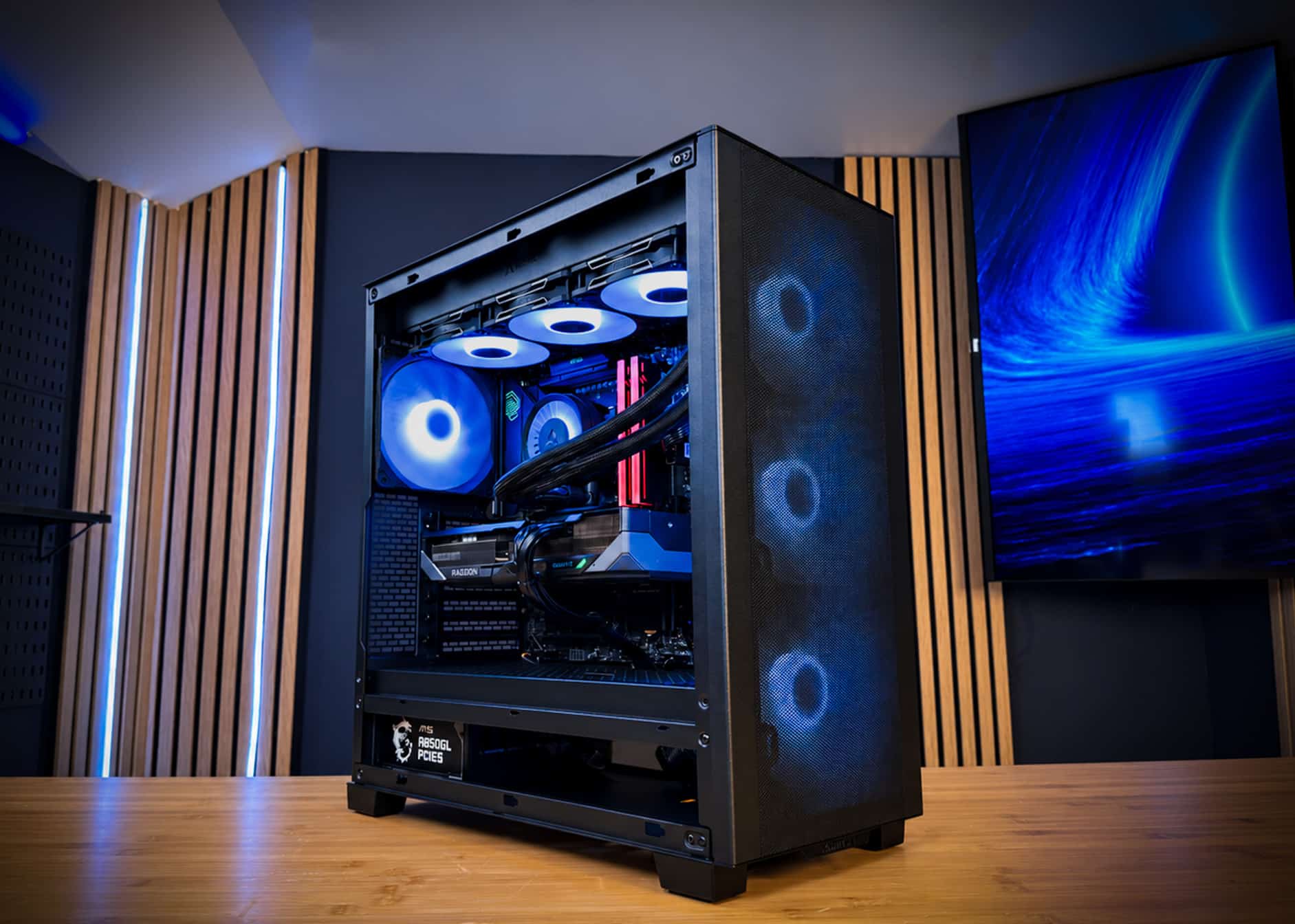
CPUBLD’s OCEAN is the exact build this guide recommends, assembled and tested for $2,899.99. It pairs the Ryzen 7 9800X3D with a Gigabyte RX 9070 XT, 32GB of DDR5-6000 and a 360mm AIO.
- CPU AMD Ryzen 7 9800X3D
- GPU Gigabyte Radeon RX 9070 XT 16GB GAMING OC
- Motherboard MSI MAG B850 TOMAHAWK MAX WIFI
- Memory Lexar THOR Z OC 32GB DDR5-6000
- Storage Kingston NV3 2TB NVMe
- Cooling ARCTIC Liquid Freezer III Pro A-RGB 360
- Case Phanteks XT PRO ULTRA
- Power MSI MAG A850GL 850W 80+ Gold
- OS Windows 11 Pro
OCEAN ships within 5–7 business days. Each one is hand-assembled and cable-managed in Jersey City, then passes a 48-hour burn-in under full load. You get a 3-year parts warranty, lifetime support and fully insured shipping to all 50 states. Affirm financing offers 0% APR options for qualified buyers.
Need a higher budget, like an RTX 5080 or RTX 5090 build? Tell us on the request form and you’ll get a parts plan and quote within 24 hours. GPU street prices change daily, so availability and price are confirmed in the quote. Or browse all of our prebuilt gaming PCs.
Frequently asked questions
What is the best gaming PC under $3,000 in 2026?
A Ryzen 7 9800X3D paired with a Radeon RX 9070 XT 16GB. Round it out with 32GB of DDR5-6000, a 2TB NVMe SSD and an 850W Gold power supply. That build fits under $3,000 complete in mid-November 2026. It delivers high-refresh 1440p gaming and solid 4K performance with FSR 4 upscaling.
Can you get an RTX 5080 gaming PC for under $3,000?
Not realistically in late 2026. RTX 5080 cards sold for roughly $1,800 to $2,300+ in mid-November, against a $999 launch price. That leaves too little for the CPU, a quality power supply and 32GB of DDR5, which alone costs around $450. Expect an RTX 5080 build to cost far more.
Is the RTX 5070 Ti better than the RX 9070 XT at this budget?
It depends on your games. The RTX 5070 Ti leads in heavy ray tracing and supports DLSS 4 Multi Frame Generation. It also cost about $1,170 at Newegg in October 2026. The RX 9070 XT sits in the same performance class for roughly $700 to $1,000, making it the better value.
Is it cheaper to build a $3,000 gaming PC yourself?
Only slightly, and only if you find good GPU and RAM prices. Equivalent parts total roughly $2,500 to $2,900 in mid-November 2026. A prebuilt adds assembly, stress testing, a single warranty and support. If GPU or memory prices land at the high end, the savings disappear entirely.
Should I wait for GPU prices to drop before buying?
Waiting carries real risk. The memory shortage driving GPU and RAM prices comes from AI data center demand. Silicon Motion expects shortages to last until 2028. AMD cards have risen far less than NVIDIA’s, so an RX 9070 XT build is a reasonable buy now rather than waiting years.


