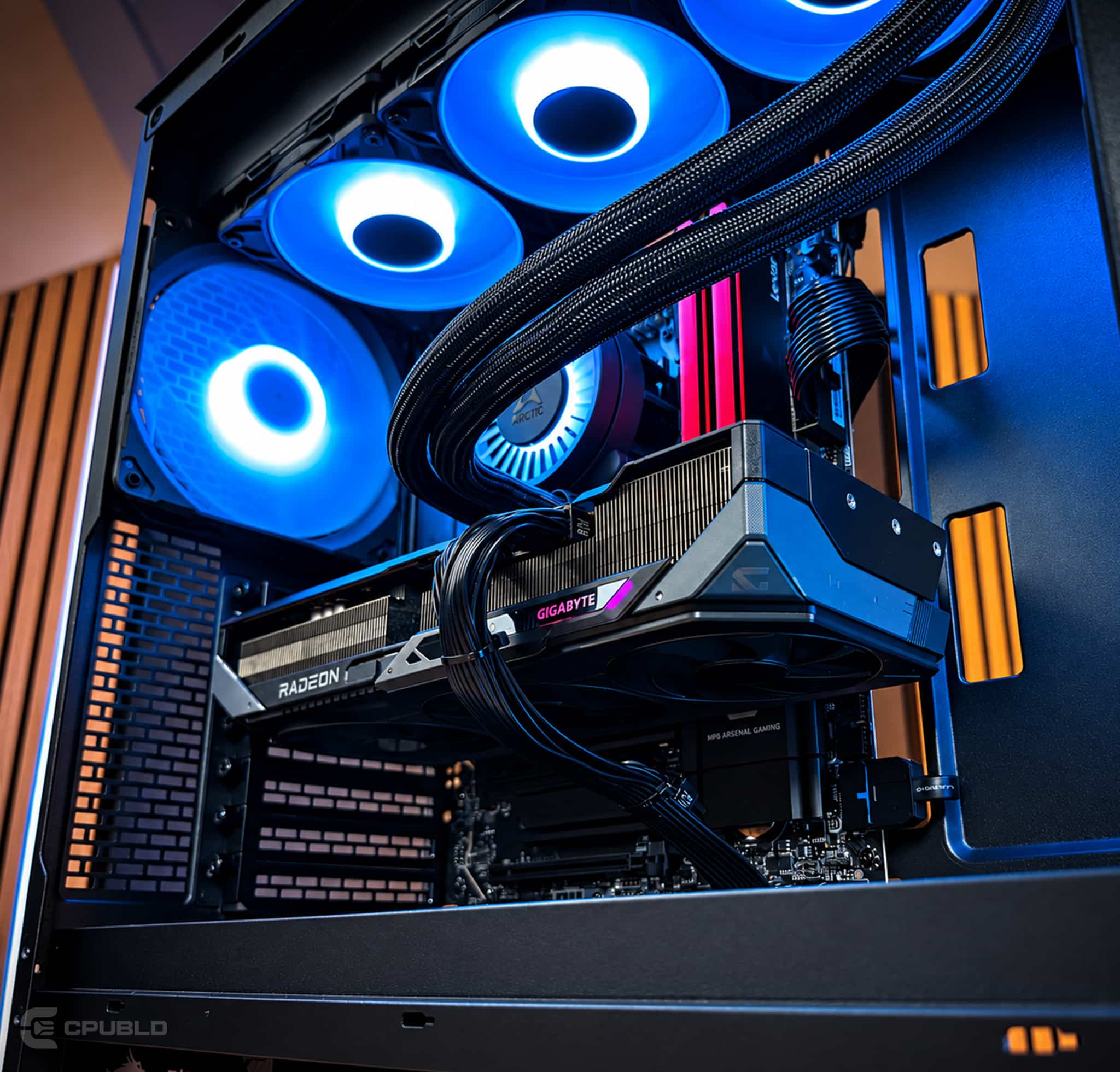
Building a gaming PC in November 2026 costs roughly ~$1,400 for a solid 1080p machine and ~$2,100 for strong 1440p. A Ryzen 7 9800X3D and RX 9070 XT build runs about $2,500 to $2,900. An RTX 5080 build lands near ~$3,600 to $4,200, and an RTX 5090 build tops ~$8,000. The short version: GPU and memory prices have pushed high-end builds far above 2024 levels, so budget for the market as it is today.

How much does each tier of gaming PC cost?
Total cost depends almost entirely on the graphics card, which now ranges from ~$400 to over $6,000.
| Tier | CPU | GPU | Total parts cost (mid-Nov 2026) |
|---|---|---|---|
| 1080p high | Ryzen 5 7600 | RX 9060 XT 16GB | ~$1,400 |
| 1440p high | Ryzen 7 9700X | RX 9070 16GB | ~$2,100 |
| 1440p ultra / 4K entry | Ryzen 7 9800X3D | RX 9070 XT 16GB | ~$2,500 to $2,900 |
| 4K high | Ryzen 7 9800X3D | RTX 5080 16GB | ~$3,600 to $4,200 |
| 4K max | Ryzen 7 9800X3D | RTX 5090 32GB | ~$8,100 to $8,600+ |
Totals include Windows 11 but exclude sales tax, a monitor and peripherals. Prices marked “~” are approximate. GPU and RAM figures come from US listings reported this fall.
Not sure which tier fits you? Our guide on how much to spend on a gaming PC matches budgets to resolutions.
Why do PC parts cost so much more in 2026?
A global memory shortage, driven by AI data centers, has pushed up the price of GPUs and RAM.
AI operators are buying DRAM and HBM years in advance. HBM is made on the same wafer capacity as DRAM and GDDR. Every wafer that goes to AI accelerators is one less for gaming memory.
JP Morgan expects DRAM prices to have climbed about 400% since 2024 by the end of 2026, according to Engadget. Silicon Motion expects the shortage to run until 2028. GDDR7, the memory on every RTX 50 card, is especially tight.
The two parts that depend most on memory chips, the GPU and the RAM kit, now take about half of a high-end build budget.
CPUs, motherboards, cases and coolers have not seen the same spikes. That is why low-memory parts look normal while the total feels inflated. Our explainer on why GPU prices are so high covers the supply chain in detail.
What do graphics cards cost right now?
NVIDIA’s RTX 50 cards sell for roughly 1.5x to 3x their launch prices, while AMD’s RX 9070 XT has risen far less.
| GPU | VRAM / power | Launch MSRP | US street price |
|---|---|---|---|
| RTX 5090 | 32GB GDDR7 / 575W | $1,999 | $6,199.99 to ~$6,599 (Nov 13–15) |
| RTX 5080 | 16GB GDDR7 / 360W | $999 | ~$1,800 to $2,300+ (mid-Nov) |
| RTX 5070 Ti | 16GB GDDR7 / 300W | $749 | $1,169.99 (Newegg, Oct 3) |
| RX 9070 XT | 16GB GDDR6 / 304W | $599 | ~$700 to $1,000 (fall 2026) |
Tom’s Hardware reported on November 15 that Newegg restocked 21 RTX 5090 models. The cheapest air-cooled cards started around $6,599, limited to one per customer. A Newegg price report cited November 13 had the cheapest new listing at $6,199.99.
For the RTX 5080, VideoCardz found a PNY card at Best Buy for $1,999.99 in late October. TweakTown spotted an ASUS Prime OC model at Micro Center for $2,349.99.
Notebookcheck and Hardware Unboxed data showed the RTX 5070 Ti, 5080 and 5090 had the steepest increases. The RX 9070 XT stayed comparatively in check, which makes it the value anchor for most builds. The RTX 5090 price breakdown explains the flagship’s spike.
What do RAM and storage cost?
A 32GB DDR5-6000 kit costs about $450 to $550 in November 2026, more than triple its 2025 price.
Memory
- 32GB DDR5-6000: about $450, per Tom’s Hardware in November 2026.
- Lowest tracked 32GB DDR5 kit: $479.99 on November 3, with a median near $550, per a basketprice tracker cited by Tech Insider.
- 2025 comparison: the same class of kit sold for well under $150.
- 16GB DDR5: ~$250, fine for 1080p but tight for newer games.
Storage
- 1TB PCIe 4.0 NVMe: ~$90.
- 2TB PCIe 4.0 NVMe: ~$150, the sensible size for a modern game library.
Buy 32GB once rather than starting at 16GB and upgrading later. Mixing kits is unreliable, and prices may not fall soon. See our DDR5 prices in 2026 breakdown and our guide on how much RAM you need for gaming.
Memory is the hidden budget killer in 2026. Plan on about $450 to $550 for 32GB of DDR5-6000, a cost that was under $150 just a year ago.
What does a full parts list look like at each budget?
These three example builds show where the money goes at the most popular price points.
- CPU Ryzen 5 7600 (~$200)
- GPU RX 9060 XT 16GB (~$400)
- Motherboard B650 (~$150)
- Memory 16GB DDR5-6000 (~$250)
- Storage 1TB NVMe (~$90)
- Power 650W 80+ Gold (~$85)
- Cooling, case, OS Tower cooler, airflow case, Windows 11 Home (~$250)
- CPU Ryzen 7 9700X (~$300)
- GPU RX 9070 16GB (~$600)
- Motherboard B850 (~$200)
- Memory 32GB DDR5-6000 (~$450)
- Storage 2TB NVMe (~$150)
- Power 750W 80+ Gold (~$100)
- Cooling, case, OS Dual-tower cooler, airflow case, Windows 11 Home (~$275)
- CPU Ryzen 7 9800X3D (~$470)
- GPU RTX 5080 16GB (~$1,800 to $2,300+)
- Motherboard B850 Wi-Fi (~$230)
- Memory 32GB DDR5-6000 ($450 to $550)
- Storage 2TB NVMe (~$150)
- Power 850W ATX 3.1 Gold (~$130)
- Cooling, case, OS 360mm AIO, mid-tower, Windows 11 Pro (~$390)
NVIDIA recommends an 850W PSU for the RTX 5080 and 1000W for the RTX 5090. For a 5090 build, add about ~$200 for a quality 1000W ATX 3.1 unit. Check our power supply guide before you buy.
What hidden costs do first-time builders miss?
Expect roughly $300 to $600 in extra costs beyond the core parts list on a high-end build.
- Windows 11: ~$140 for Home or ~$200 for Pro if you buy a retail license.
- Sales tax: varies by state, often several hundred dollars on a $3,000 parts order.
- Cables: some RX 9070 XT and RTX 50 cards use 12V-2×6. Use a native cable from an ATX 3.1 PSU, not an adapter.
- Returns and failures: a dead-on-arrival part can stall a build for a week or more.
- Your time: assembly, BIOS updates, drivers and stress testing take a full day or more.
Connector safety deserves real attention. Guru3D reported in February 2026 that a Gigabyte AORUS RTX 5090 Master ICE melted even when power-limited to 500W. Seat the plug fully and avoid sharp bends near the connector.
Your parts list is not your final bill. Add Windows, tax and a full day of assembly and testing before comparing a DIY build against a complete system.
Is it cheaper to build or buy a prebuilt in 2026?
At the high end, building yourself now saves a few hundred dollars at most, and often nothing.
Take a 9800X3D and RX 9070 XT build with a 360mm AIO, 2TB SSD and Windows 11 Pro. The parts total roughly $2,500 to $2,900 in mid-November 2026. CPUBLD’s OCEAN uses that exact configuration for $2,899.99, assembled and stress tested.
The best case for DIY requires an RX 9070 XT near $700 and RAM near $450. If either lands at the high end of its range, the gap closes. Our GPU alone vs complete prebuilt analysis runs the numbers in more detail. For top picks at this price, see the best gaming PC under $3,000.
Black Friday 2026 falls on Friday, November 27. With memory supply this tight, treat any GPU or RAM discount as a bonus rather than a plan.
Looking for a gaming PC without the parts hunt?
OCEAN is the high-end build from our cost table, already assembled, tested and ready to ship for $2,899.99. It skips the daily GPU and RAM price checks entirely.
- CPU AMD Ryzen 7 9800X3D
- GPU Gigabyte Radeon RX 9070 XT 16GB GAMING OC
- Motherboard MSI MAG B850 TOMAHAWK MAX WIFI
- Memory Lexar THOR Z OC 32GB DDR5-6000
- Storage Kingston NV3 2TB NVMe
- Cooling ARCTIC Liquid Freezer III Pro A-RGB 360
- Case Phanteks XT PRO ULTRA
- Power MSI MAG A850GL 850W 80+ Gold
- OS Windows 11 Pro
OCEAN ships within 5–7 business days. It is hand-assembled and cable-managed in Jersey City, then runs a 48-hour burn-in under full load. Every system includes a 3-year parts warranty, lifetime support and fully insured shipping to all 50 states. Affirm financing offers 0% APR options for qualified buyers.
Want a different tier, like an RTX 5080 or RTX 5090 build? Tell us on the request form and you’ll get a parts plan and quote within 24 hours. GPU street prices change daily, so parts availability and price are confirmed in the quote. Or browse all of our prebuilt gaming PCs.
Frequently asked questions
How much does it cost to build a gaming PC in 2026?
In mid-November 2026, expect roughly $1,400 for a 1080p build and $2,100 for 1440p. A Ryzen 7 9800X3D and RX 9070 XT build costs about $2,500 to $2,900. RTX 5080 builds run near $3,600 to $4,200, and RTX 5090 builds exceed $8,000.
Why is building a gaming PC so expensive right now?
AI data centers are buying huge amounts of DRAM and HBM, which squeezes supply of gaming memory. That raises the price of GPUs and RAM kits. JP Morgan expects DRAM prices to be up about 400% since 2024 by the end of 2026, and Silicon Motion expects shortages until 2028.
How much should I budget for RAM in 2026?
Plan on about $450 to $550 for a 32GB DDR5-6000 kit as of November 2026. The lowest tracked 32GB kit was $479.99 on November 3, with a median near $550. The same kit cost well under $150 in 2025, so memory is now a major line item.
Is it cheaper to build or buy a gaming PC in 2026?
At the high end, the gap is small. Parts for a 9800X3D and RX 9070 XT build total roughly $2,500 to $2,900, close to the price of a complete tested system. Once you add tax, your time and the risk of faulty parts, buying built often makes more sense.
What is the cheapest way to get high-end gaming performance in 2026?
Pair a Ryzen 7 9800X3D with an RX 9070 XT. AMD’s card launched at $599 and sells for roughly $700 to $1,000, while NVIDIA’s RTX 5070 Ti and 5080 prices rose much more. The combination handles high-refresh 1440p and 4K with FSR 4 upscaling for far less.


