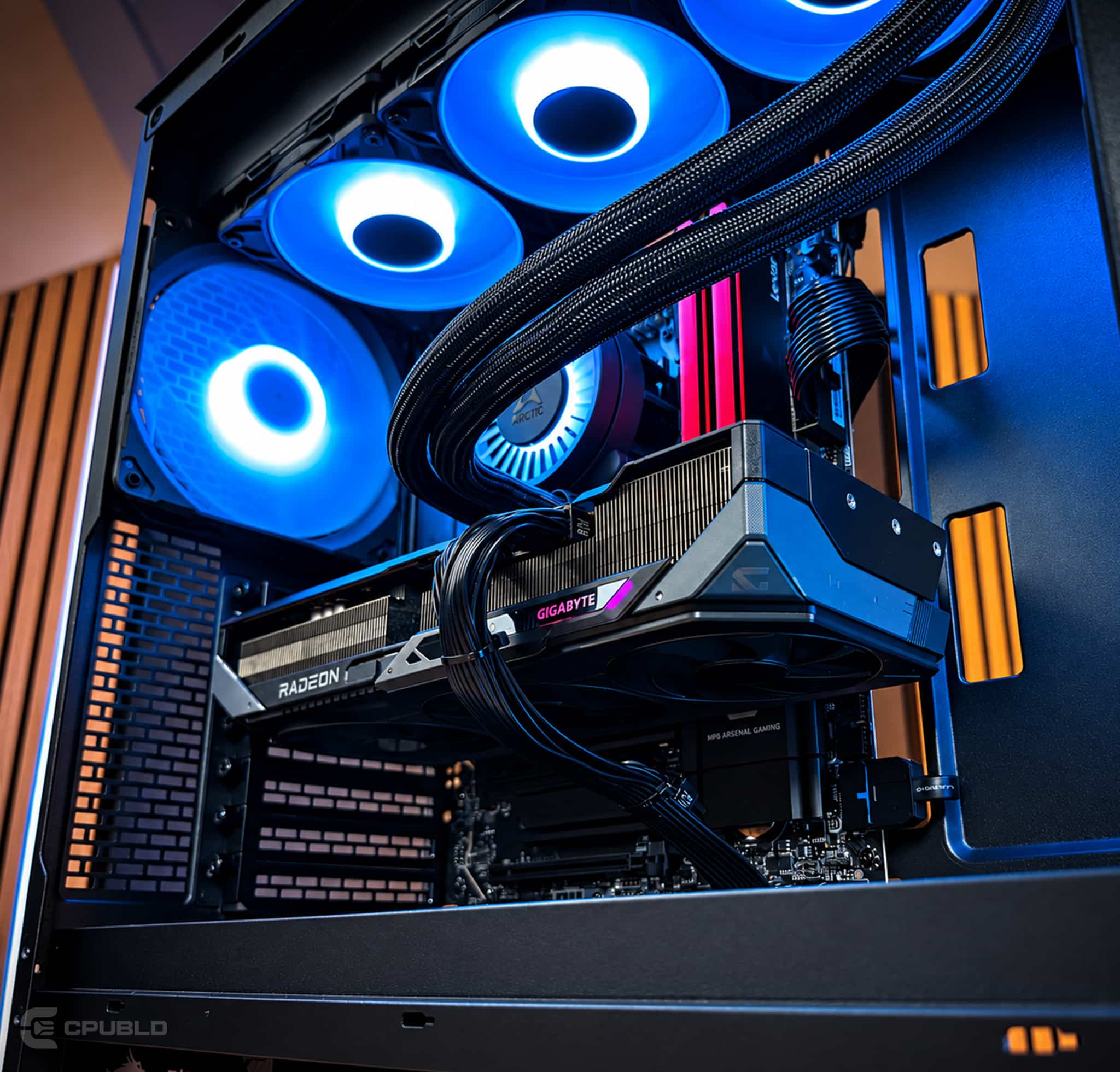
The RTX 5090 is the fastest gaming GPU you can buy, and it is not close. In the 3DMark Speed Way result reported by SpecPicks in November 2026, the RTX 5090 scored 15,488 against 9,010 for the RTX 5080. That is roughly 72% more performance. But as of mid-November 2026, the cheapest new RTX 5090 costs over $6,000, while an RTX 5080 sells for roughly $1,800 to $2,300+. The short version: the RTX 5090 only pays off for 4K path tracing, heavy VRAM needs and budgets that can absorb a $4,000+ premium. For almost everyone else, the RTX 5080 or a well-built RX 9070 XT system is the smarter buy right now.

RTX 5090 vs RTX 5080: the specs side by side
The RTX 5090 doubles the RTX 5080’s memory and draws about 60% more power. Otherwise, the feature sets match.
| Spec | RTX 5090 | RTX 5080 |
|---|---|---|
| VRAM | 32GB GDDR7 | 16GB GDDR7 |
| Total graphics power | 575W | 360W |
| NVIDIA recommended PSU | 1000W | 850W |
| Power connector | 12V-2×6 | 12V-2×6 |
| 3DMark Speed Way (SpecPicks) | 15,488 | 9,010 |
| Launch MSRP | $1,999 (Founders Edition) | $999 |
| Street price, mid-Nov 2026 | ~$6,199 to $6,599+ | ~$1,800 to $2,300+ |
| DLSS 4 Multi Frame Generation | Yes | Yes |
What the numbers mean for gaming
- Performance: about 72% higher in Speed Way, a demanding ray-traced test that maps well to 4K gaming.
- VRAM: 32GB gives the 5090 huge headroom for 4K textures, mods and path tracing.
- Power: 575W versus 360W means more heat, a bigger PSU and a larger case.
- Features: identical. Neither card gets a DLSS feature the other lacks.
How much faster is the RTX 5090 in games?
At 4K with heavy ray tracing, the RTX 5090 is clearly faster, often by well over 50%. That gap shrinks fast at lower resolutions.
At 1440p, many games become limited by the CPU rather than the GPU. Even a Ryzen 7 9800X3D, with its 96MB of L3 cache, can only feed frames so quickly. Here the RTX 5080 already runs most titles well above 144 FPS on high settings. The 5090’s extra muscle often goes unused.
At 1080p, the comparison is close to meaningless. Esports games like Valorant and CS2 run at several hundred FPS on either card.
At 4K, the story flips. Path-traced games like Cyberpunk 2077 push both cards hard. This is where the 5090’s extra shader power and 32GB of memory pay off. With DLSS 4 upscaling and Multi Frame Generation, both cards can reach high frame rates. The 5090 just gets there with higher base frame rates, which means lower latency and fewer artifacts.
The RTX 5090’s lead is real but resolution-dependent. At 1440p and below, a 9800X3D-class CPU often caps both cards, so most of the extra $4,000 buys frames you will not see.
The price gap in November 2026
As of mid-November 2026, the gap between these two cards is about $4,000, not the $1,000 it was at launch.
Tom’s Hardware reported on November 15 that Newegg restocked 21 RTX 5090 models. The cheapest air-cooled cards started around $6,599, at least triple MSRP, with a limit of one per customer. A Newegg price report cited on November 13 had the cheapest new listing at $6,199.99.
The RTX 5080 is inflated too, just less. VideoCardz’s October 28 survey found US prices near $2,000, including a PNY RTX 5080 at Best Buy for $1,999.99. TweakTown spotted an ASUS Prime OC RTX 5080 at Micro Center for $2,349.99. For more on how that happened, see our breakdowns of the RTX 5090 price and the RTX 5080 price.
Cost per unit of performance
- At launch MSRP: the 5090 cost 2x as much for about 72% more Speed Way performance. Expensive, but defensible.
- At mid-November street prices: the 5090 costs roughly 3x as much as a $2,000 RTX 5080 for the same 72%.
- Dollars per Speed Way point: about $0.40 for a $6,199.99 RTX 5090 versus about $0.22 for a $1,999.99 RTX 5080.
At launch, the RTX 5090 was a premium. In November 2026, it is a luxury tax: you pay nearly double per frame for the same 72% lead.
Why are both cards so expensive?
A global memory shortage driven by AI data centers is the main reason both cards cost far above MSRP.
AI buyers are reserving DRAM and HBM years in advance. HBM competes for the same wafer capacity as DRAM and GDDR, so graphics memory gets squeezed. GDDR7, which every RTX 50 card uses, is constrained. JP Morgan expects DRAM prices to be up about 400% from 2024 by the end of 2026, according to Engadget. Silicon Motion expects shortages to last until 2028.
The RTX 5090 carries 32GB of that scarce GDDR7. That helps explain why it took the worst price hit. Notebookcheck and Hardware Unboxed data showed the RTX 5070 Ti, 5080 and 5090 had the steepest increases. The RX 9070 XT stayed comparatively in check. Our explainer on why GPU prices are so high covers the full supply chain.
Discontinuation rumors and the cancelled 24GB RTX 5080
Neither card is confirmed as discontinued, and you should not panic-buy because of rumors.
In October 2026, leaker Moore’s Law Is Dead claimed NVIDIA was discontinuing the RTX 5090 and RTX 5080. NVIDIA’s SVP Jeff Fisher said RTX 5090 shipments would continue, while admitting supply is constrained, as reported by Notebookcheck. As of November 16, NVIDIA still lists the RTX 5090 as an active product. Treat the discontinuation story as an unconfirmed rumor that NVIDIA has denied. We track the details in Is the RTX 5090 discontinued?
The rumored 24GB RTX 5080, often called the “5080 Super,” is a different matter. Board Channels reported on November 11 that its launch was cancelled, via Overclock3D and The FPS Review. NVIDIA never announced it. If you were waiting for a middle-ground card with more VRAM, that option has reportedly gone away. See our 24GB RTX 5080 report for what that means for upgrade timing.
NVIDIA’s November 12 leadership change has not altered the plan either. Its board said the product roadmap continues without interruption.
Power, heat and the 12V-2×6 connector
The RTX 5090 needs a stronger power supply, more cooling and more care with its power cable than the RTX 5080.
NVIDIA recommends a 1000W PSU for the 5090 and 850W for the 5080. A 575W card dumps a lot of heat into your case, so airflow and case size matter. The 5090 is also the card most associated with 12V-2×6 melt reports. Guru3D reported in February 2026 that a Gigabyte AORUS RTX 5090 Master ICE melted even when limited to 500W. Melts have also been reported on RTX 5080 cards, so neither is immune.
How to protect either card
- Use an ATX 3.1 power supply with a native 12V-2×6 cable. Skip adapters.
- Push the plug in fully until it clicks and sits flush.
- Avoid sharp bends near the plug and any sideways strain on the cable.
- Size the PSU to NVIDIA’s guidance: 1000W for a 5090, 850W for a 5080.
Our guide on the RTX 5090 melting connector goes deeper. For sizing, read what power supply you need for a gaming PC.
Budget for a 1000W ATX 3.1 PSU, a large airflow case and careful cable routing if you choose the RTX 5090. The RTX 5080’s 360W draw is far easier to cool and power.
Who should buy the RTX 5090, and who should buy the RTX 5080?
Buy the RTX 5090 only if you need 32GB and maximum 4K headroom; otherwise the RTX 5080 delivers far more per dollar.
The RTX 5090 makes sense if you
- Play at 4K on a 144Hz or faster monitor with path tracing turned on.
- Run heavy texture mods or VR titles that can use more than 16GB of VRAM.
- Also do AI, 3D rendering or video work where 32GB pays for itself. Our RTX 5090 vs RTX PRO guide covers that side.
- Can spend $6,000+ on the GPU alone without stretching your budget.
The RTX 5080 makes sense if you
- Game at 1440p high refresh or 4K with DLSS 4 upscaling.
- Want DLSS 4 Multi Frame Generation at about a third of the 5090’s current street price.
- Prefer an 850W system with lower heat and noise.
Consider the RX 9070 XT if you
- Play mostly at 1440p and want the best value in this market.
- Like that AMD prices have risen less, with US listings roughly $700 to $1,000 this fall.
- Are fine with FSR 4 instead of DLSS 4. Compare them in DLSS 4 vs FSR 4 and RTX 5080 vs RX 9070 XT.
The $4,000 gap buys the best 4K experience available. If you are not gaming at 4K with path tracing, that money does far more as a complete, balanced system.
Looking for a gaming PC?
If the RTX 5090’s price made you rethink the whole budget, OCEAN is our answer. It pairs the Ryzen 7 9800X3D with a 16GB RX 9070 XT for strong 1440p and capable 4K gaming. The complete system costs less than half of what a single RTX 5090 card sells for today.
- CPU AMD Ryzen 7 9800X3D
- GPU Gigabyte Radeon RX 9070 XT 16GB GAMING OC
- Motherboard MSI MAG B850 TOMAHAWK MAX WIFI
- Memory Lexar THOR Z OC 32GB DDR5-6000
- Storage Kingston NV3 2TB NVMe
- Cooling ARCTIC Liquid Freezer III Pro A-RGB 360
- Case Phanteks XT PRO ULTRA
- Power MSI MAG A850GL 850W 80+ Gold
- OS Windows 11 Pro
OCEAN ships within 5–7 business days. Every unit is hand-assembled and cable-managed in Jersey City, then put through a 48-hour burn-in under full load. You get a 3-year parts warranty, lifetime support and fully insured shipping to all 50 states. Affirm financing offers 0% APR options for qualified buyers.
Still set on an RTX 5080 or RTX 5090 build? Tell us on the request form and you’ll get a parts plan and quote within 24 hours. GPU street prices change daily, so we confirm availability and pricing in the quote. Or browse all of our prebuilt gaming PCs.
Frequently asked questions
How much faster is the RTX 5090 than the RTX 5080?
In the 3DMark Speed Way result reported by SpecPicks, the RTX 5090 scored 15,488 versus 9,010 for the RTX 5080, about 72% higher. In real games the gap is largest at 4K with ray tracing. It shrinks at 1440p and 1080p, where the CPU often limits both cards.
Is the RTX 5090 worth $4,000 more than the RTX 5080?
For most gamers, no. As of mid-November 2026 the cheapest new RTX 5090 costs over $6,000, while the RTX 5080 sells for roughly $1,800 to $2,300+. The premium only makes sense for 4K path tracing, heavy VRAM use, or paid creative and AI work.
Is 16GB of VRAM on the RTX 5080 enough for 4K?
For most current games, yes. The RTX 5080’s 16GB of GDDR7 handles 4K well, especially with DLSS 4 upscaling. The RTX 5090’s 32GB matters more for extreme texture mods and native 4K path tracing. It also helps AI and 3D rendering work that fills memory quickly.
What power supply do the RTX 5090 and RTX 5080 need?
NVIDIA recommends a 1000W power supply for the 575W RTX 5090 and an 850W unit for the 360W RTX 5080. Choose an ATX 3.1 PSU with a native 12V-2×6 cable, avoid adapters, seat the plug fully, and keep sharp bends away from the connector.
Is the RTX 5090 being discontinued?
Not according to NVIDIA. A leaker claimed in October 2026 that the RTX 5090 and 5080 were ending. NVIDIA’s SVP Jeff Fisher said RTX 5090 shipments would continue despite constrained supply. As of November 16, NVIDIA still lists the card as active. Treat the rumor as unconfirmed.


